Hostels vs. Cheap Hotels: Key Differences
Short answer
Hostels are cheaper and more social. You rent a bed in a shared dorm and get communal kitchens and lounges. Cheap hotels cost more but give you a private room, a lockable door and usually your own bathroom. Choose a hostel to save money and meet people, and a cheap hotel when you need quiet and reliable sleep for work.
It's late afternoon when you step off the bus. Your backpack straps are biting into your shoulders, your phone is at eleven percent, and you still have two booking tabs open. One is a hostel two streets from the old town, its photos full of exposed brick, fairy lights and long communal tables strewn with half-finished bottles of local beer. The other is a modest hotel near the station. It's beige and quiet, with a bed that looks like it would actually let you sleep. The price gap is small enough to be annoying and large enough to matter across a month.
For remote workers and slow travellers, this choice comes up again and again, and it is rarely just about money. Where you sleep shapes how you work and who you meet. It decides how rested you feel for Monday morning's client call, and how long you can sustain life on the move before something starts to fray.
This guide walks through the real differences between hostels and cheap hotels: the cost beyond the headline rate, what each means for your workday, and the social trade-offs. It ends with a practical way to decide which one fits the trip you are actually on, rather than the one you imagine.
What Actually Separates a Hostel From a Cheap Hotel
What Actually Separates a Hostel From a Cheap Hotel
Feature-by-feature comparison of what you get when you book a hostel bed versus a cheap hotel room.
| Feature | Hostel Dorm | Cheap Hotel |
|---|---|---|
| Sleeping space | Shared bed in dorm | Private room |
| Bathroom | Shared facilities | Private or en-suite |
| Kitchen access | Full shared kitchen | Usually none |
| Common spaces | Lounge, courtyard, rooftop | Reception area only |
| Other travellers | Always present | None in your room |
Illustrative figures — composed for shape, not sourced
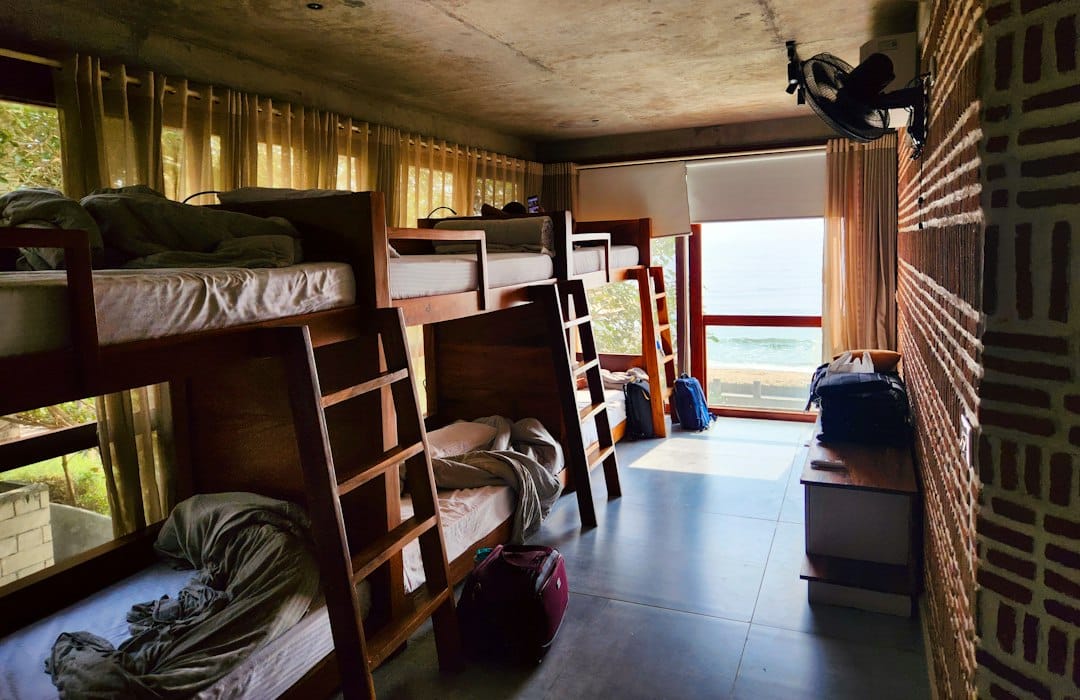
The core difference is what you're renting. In a hostel, you typically rent a bed: a bunk in a dorm of four, eight or sometimes far more. With it comes access to shared spaces. There's a kitchen where someone is always boiling pasta, a lounge with mismatched sofas and a bookshelf of abandoned paperbacks, lockers and laundry, and often a rooftop or courtyard. In a cheap hotel, you rent a room. It may be small and the decor may have been chosen sometime in the previous decade, but the door locks behind you and the four walls are yours.
That line has blurred in recent years. Many modern hostels offer private rooms with en-suite bathrooms, sometimes at prices that rival budget hotels, while still giving you the kitchen and common areas. Some style themselves as boutique hostels, with designer interiors, coworking corners and cafes on the ground floor. Meanwhile, simple hotels and family-run guesthouses in parts of Southeast Asia, Latin America and Southern Europe can be startlingly affordable, especially when you book directly or stay longer than a few nights.
So the useful question isn't hostel or hotel in the abstract. It's which bundle of features you're paying for. Is the sleeping space shared or private? Is the bathroom? Is there a kitchen? Will other travellers be around, and how reliable are the staff and amenities? Once you see each option as a bundle rather than a category, comparing them becomes far less emotional and far more practical.
The Real Cost Picture: Beyond the Nightly Rate
On paper, a dorm bed almost always wins. But the nightly rate is only the opening number. A hostel kitchen means you can shop at the local market and cook most of your meals: paper-wrapped cheese, a bag of tomatoes still warm from the stall, a loaf of bread that costs less than a coffee. Over a long stay, that can save more than the bed itself. Free breakfasts, walking tours and shared laundry stretch your budget further. A cheap hotel rarely has a kitchen, so you end up eating out three times a day, and that quietly adds up.
The sums shift once you count the cost of poor sleep. If a dorm's 3am arrivals leave you foggy, you might buy extra coffees or spend afternoons in cafes just to get a functioning seat. You might end up paying for a coworking day pass you hadn't planned on. Lockers may need your own padlock, and towels can be an extra charge. Travelling as a pair changes things entirely: two dorm beds can cost close to, or more than, one private double in a modest hotel.
Longer stays reward negotiation on both sides. Many guesthouses and small hotels will offer weekly or monthly rates if you ask in person or by message, and some hostels run long-stay deals for remote workers. If you're planning a month or more in one place, it's also worth comparing both against affordable co-living spaces for digital nomads. These often bundle a private room, a proper desk and a ready-made community into a single monthly price.
Enjoying this? Get more like it.
Weekly picks for remote workers and digital nomads — tools, destinations, and honest takes, straight to your inbox.
Subscribe free →Working Remotely: Wi-Fi, Desks and the Search for Quiet
Picture the scene. It's 9am and your call starts in ten minutes. The hostel common room is full of last night's party crowd eating cereal at the only table near the router. Someone is gently murdering a song on the house guitar, and the Wi-Fi icon flickers between two bars and none. This is hostel remote work at its worst, and it happens often enough that experienced nomads learn to plan around it.
Not every hostel is like that. A growing number are built with remote workers in mind. They offer quiet rooms, real desks, decent chairs and fibre connections, sometimes with recent speed tests posted at reception. But even in the best of them, you're sharing bandwidth with dozens of people who are streaming, uploading and video-calling home. A cheap hotel room gives you a door to close and a corner for calls without an audience. It also gives you a surface that is yours for the day, even if it's just a narrow desk under a wall-mounted television.
Before booking either, read recent reviews and search them for words like Wi-Fi, desk, quiet and work. Message the property and ask directly about upload speeds and whether there's somewhere to take calls. Carry a backup, such as a local SIM with a generous data plan or a portable hotspot, so a bad connection never becomes a missed deadline. If your work is call-heavy, treat a private room as a business expense rather than a luxury.
Social Life, Solitude and Your Energy Levels
There is a particular magic to hostel evenings. The kitchen fills with the smell of garlic and someone's improvised curry, and conversations drift between three or four languages. By the end of the night you've made plans to hike a volcano with people you met two hours earlier. For solo travellers especially, hostels remove the friction of meeting people. You don't have to be bold. You just have to show up at the shared table.
Hotels offer the opposite gift: solitude. There's the hush when the door clicks shut, the luxury of spreading your things across a whole room, and the freedom to switch off the light whenever you like. After a day of navigating a new language, a crowded market and a hard deadline, that silence can feel like oxygen. Introverts, and anyone in an intense stretch of work, often need it more than they expect.
Over months of travel, this balance matters more than any single night. Constant socialising, broken sleep and zero privacy are fast routes to exhaustion, and many nomads only notice the pattern once they're running on empty. The warning signs are covered in our guide to mastering digital nomad burnout. Constant isolation brings its own kind of loneliness, though. The sweet spot for many people is a rhythm: a hostel when you arrive somewhere new and want company, then a quieter room once the work week ramps up.
How to Choose: Matching the Room to the Trip
Hostel or cheap hotel decision guide
A step-by-step process to decide between a hostel and a cheap hotel based on your work, travel party and length of stay.
Is your week full of video calls, client deadlines or deep-focus work?
Hostel dorm viable
Lighter workload suits shared space and social energyAre you travelling solo?
Private room likely better value
Couples and groups pay more for multiple dorm bedsAre you staying longer than a week?
Short-stay hostel workable
Chaos is easier to tolerate for just a few nightsBook the private room or hostel private
Your workload and length of stay align best with privacy and quietIllustrativeA rule of thumb from the advice above. No figures shown.
Start with your workload. If your week is full of video calls, client deadlines or deep-focus work, lean towards a cheap hotel or a hostel private room. If it's a lighter week, you're between contracts, or your work is mostly asynchronous and can move to a cafe, a dorm becomes far more viable. It also becomes far more fun.
Next, consider who you're with and how long you're staying. Solo travellers get the biggest financial and social benefit from hostels. Couples and small families usually find a budget hotel or private room better value once two or more beds are involved. For a few nights, a dorm's chaos is easy to tolerate. Over a few weeks, the weight of shared space builds up, and a room with a kitchen or a weekly hotel rate tends to win.
Finally, think about the place itself. Where budget hotels are inexpensive, the gap is often so small that a private room is a sensible default. In pricier cities, a hostel might be the only realistic way to stay central. If you're choosing where to base yourself, our roundup of slow travel cities for digital nomads on a budget highlights destinations where your money stretches furthest, whichever kind of bed you choose.
Mistakes That Turn a Bargain Into a Bad Week
The most common mistake is booking on photos alone. A wide-angle lens can make a cramped dorm look like a loft and a dim hotel room look airy and bright. Sort reviews by newest and read the last few weeks rather than the overall score. Look for patterns, not one-off complaints: repeated mentions of thin walls, broken air conditioning, bed bugs or patchy Wi-Fi are rarely coincidences.
The second is ignoring location and atmosphere. A cheap room an hour from everything costs you in transport, time and energy every day. Equally, some hostels are proudly built for nightlife. If the listing mentions an in-house bar, nightly pub crawls or drinking games, believe it. That can be a brilliant weekend, but it's a miserable base for a week of deadlines. Some cheap hotels sit above busy bars or on main roads where the traffic never really stops, so check the map before you commit.
The third is locking in too long, too early. A month prepaid sounds efficient until you discover the desk wobbles, the mattress sags and the street outside is under construction. Book two or three nights first, test the Wi-Fi during your actual working hours, and walk the neighbourhood after dark. If it all feels right, extend in person. Staff are often happy to offer a better rate to someone already there.
In the end, neither a hostel nor a cheap hotel is better in any absolute sense. Each is a tool, and the right one depends on the week you're facing. Hostels give you community, a kitchen and the lowest possible cost for a solo traveller. Cheap hotels give you privacy, quiet and a door you can close on the world when work demands it. Many of the most sustainable nomad routines move between the two, choosing deliberately rather than by habit.
So the next time you're standing at a bus station with two tabs open and a dying phone, ask yourself a different question. Don't ask which one is cheaper. Ask what you'll need tomorrow morning when you wake up there. Maybe it's laughter around a shared table and a stranger offering to split a taxi to the coast. Maybe it's a quiet room, a cup of coffee and the soft hum of a laptop booting up. Answer that honestly, and the right bed usually chooses itself.
FAQ
can you cook meals in a hostel
Yes, most hostels have a shared kitchen where you can shop at local markets and cook your own meals, which can save significantly on food costs over a long stay compared to eating out three times a day at a cheap hotel.
is wifi reliable in hostels for remote work
Wifi quality varies in hostels. While some modern hostels built for remote workers offer decent connections with recent speed tests posted, you're typically sharing bandwidth with dozens of other guests. It's important to read recent reviews, ask about upload speeds before booking, and have a backup connection like a local SIM or portable hotspot for call-heavy work.
are hostels cheaper than budget hotels for couples
Not necessarily. When travelling as a pair, two dorm beds can cost close to or more than a single private double room in a modest hotel, making budget hotels better value for couples.
how long should i book a hostel or hotel at first
It's best to book just two or three nights initially so you can test the wifi during actual working hours and walk the neighbourhood before committing longer. Staff are often happy to offer a better rate if you extend in person after deciding the place works for you.
Sources
Illustrative, composed for shape rather than sourced: What Actually Separates a Hostel From a Cheap Hotel; How to Choose: Matching the Room to the Trip. Updated 4 Oct 2026.