Best Luggage for Long-Term Travel
Long-term travel changes everything you thought you knew about luggage. A bag that felt perfectly fine on a two-week holiday becomes a source of daily frustration when it's your home for six months, a year, or indefinitely. The wheels that squeaked once now squeak every single day. The zipper that was slightly stiff eventually fails at the worst possible moment — say, in a train station in Bratislava at midnight.
For remote workers and location-independent professionals, luggage is infrastructure. It carries the tools that make income possible — a laptop, chargers, adapters, maybe a portable monitor — alongside enough clothing and gear to live comfortably in wildly different climates. The right choice pays for itself in durability, back health, and the sheer relief of not fighting your bag every travel day.
This guide breaks down what actually matters for long-haul, extended travel — the categories worth considering, the features that separate great bags from disposable ones, the mistakes that cost people money, and how to match your luggage to the way you really travel. No breathless hype, just what works when a bag has to survive years, not weeks.

Backpack vs. Wheeled: Choosing Your Base Camp
Backpack vs. Wheeled: Choosing Your Base Camp
Feature comparison between backpacks and wheeled luggage for long-term travel.
| Feature | Backpack | Wheeled Luggage |
|---|---|---|
| Durability (Years) | 5–8 years | 3–5 years |
| Weight Distribution | Shoulders & hips | Wheels bear load |
| Rough Terrain Access | Unrestricted | Cobblestone, stairs |
| Organization | Limited pockets | Multiple compartments |
| Mobility & Comfort | Both hands free | One hand on handle |
| Best For Long-Term | Recommended | Secondary option |
Illustrative figures — composed for shape, not sourced
The first and biggest decision is whether you go wheels or straps. Travel backpacks give you total freedom over cobblestones, staircases without lifts, unpaved paths, and crowded transit systems where wheeled bags become a liability. If your itinerary leans toward Southeast Asia, older European cities, or anywhere with unreliable infrastructure, a well-fitted backpack keeps your hands free and your body mobile.
Wheeled luggage, on the other hand, spares your spine on long airport walks and suits travellers who move city-to-city on smooth surfaces and stay put for weeks at a time. Hardshell spinners protect fragile tech and glide effortlessly through terminals, though they punish you the moment you hit stairs or gravel. Many long-term travellers eventually land on a hybrid approach: a wheeled main bag paired with a backpack for daily use and carry-on.
There's no universally correct answer, only the one that fits your body and your route. If you're still weighing the fundamentals, our deep dive on the best luggage types for international travel walks through each category in more detail. The key rule: honestly assess how much lifting, carrying, and stair-climbing your travel style involves before you commit.
The Case for Carry-On Only (Even for a Year Abroad)
It sounds counterintuitive, but many of the most seasoned long-term travellers live out of a single carry-on indefinitely. The logic is compelling: you never wait at baggage claim, never pay checked-bag fees, never lose your belongings to an airline mishandling, and you're never physically overwhelmed when you land somewhere new and tired. A tight kit forces discipline, and discipline is what keeps long-term travel sustainable.
The trick to making carry-on work for months at a time isn't a bigger bag — it's smarter packing. Compression is your best friend here. Squeezing bulky clothing down to a fraction of its volume frees up space for the tech and comfort items that actually matter. If you want the honest comparison, read compression packing cubes vs. regular cubes before you buy anything.
Carry-on living does require accepting some trade-offs — fewer wardrobe options, careful liquid management, and staying under strict airline weight limits that vary by carrier. But for anyone doing slow travel and staying weeks per destination, laundry access makes a minimal wardrobe entirely workable. Once you experience the freedom of walking straight off a plane and out the door, checked luggage starts to feel like a burden you invented for yourself.
Enjoying this? Get more like it.
Weekly picks for remote workers and digital nomads — tools, destinations, and honest takes, straight to your inbox.
Subscribe free →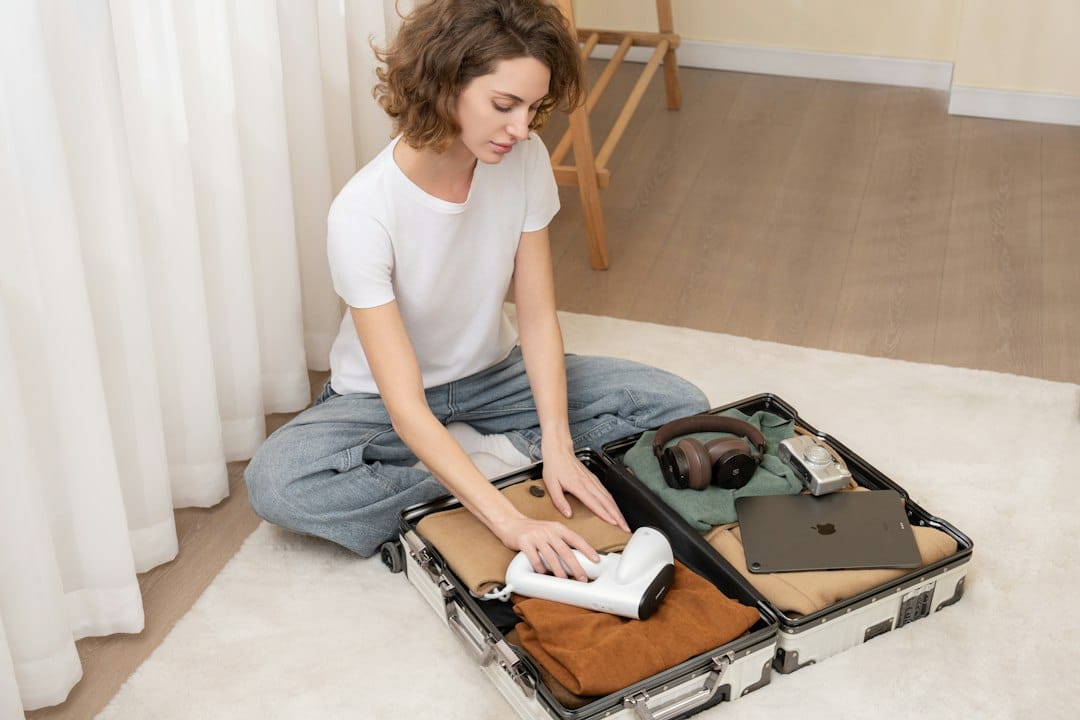
Features That Actually Matter Over the Long Haul
When a bag has to survive years rather than a single trip, the details you'd overlook on a cheap suitcase become dealbreakers. Zippers are the number one failure point — look for chunky, self-repairing coil zippers with metal pulls, ideally lockable. Wheels are second: on wheeled luggage, oversized rubberised wheels handle rough surfaces far better than the small hard plastic ones on budget models, and replaceable wheels are worth seeking out because they will eventually wear down.
For backpacks, the suspension system is everything. A proper hip belt transfers weight off your shoulders and onto your legs, which is the difference between arriving refreshed and arriving in pain after a long transit day. Adjustable torso length, a ventilated back panel, and load-lifter straps aren't marketing fluff — they're the ergonomics that protect your body over hundreds of travel days. A clamshell opening that unzips like a suitcase, rather than a top-loading design, makes living out of your bag dramatically easier.
Tech travellers should prioritise a dedicated, padded laptop compartment that opens flat for security screening — it saves you from unpacking everything at every checkpoint. Our guide to the best carry-on luggage for tech travel covers the bags built specifically around protecting your gear. Finally, factor in warranty: brands offering lifetime or multi-year guarantees signal genuine confidence in their build quality, and that coverage is invaluable when you're the one putting the bag through daily abuse.
Common Mistakes That Cost Long-Term Travellers
Common Mistakes That Cost Long-Term Travellers
Frequent packing errors and their financial and practical consequences for extended travel.
| Mistake | Cost Impact | Severity | Preventable |
|---|---|---|---|
| Overpacking from home | Excess baggage fees: $100–400 | High | Yes |
| Poor wheel protection | Wheel repair: $80–150 | Medium | Yes |
| Inadequate padding | Damaged electronics: $200+ | High | Yes |
| Wrong size for flights | Gate checking: $50–200 | Medium | Yes |
Illustrative figures — composed for shape, not sourced
The most expensive mistake is buying too big. A cavernous bag feels reassuring in the shop, but it's a trap — you will fill every litre of space regardless of size, and a 70-litre pack fully loaded is a genuine strain on your body and a magnet for baggage fees. Experienced travellers consistently report downsizing over time, never upsizing. Start smaller than feels comfortable and let necessity, not fear, dictate what you carry.
The second common error is chasing the lowest price. Cheap luggage is a false economy for extended travel — a bag that fails after three months and needs replacing twice a year costs far more than a quality bag that lasts a decade, to say nothing of the stress of a blowout mid-trip. That said, the most expensive designer luggage isn't automatically the most durable either. Look for brands respected specifically within the travel and outdoor community rather than fashion labels charging for the logo.
Finally, many travellers ignore airline rules until it's too late. Carry-on size and weight limits vary significantly between carriers, and budget airlines enforce them aggressively with painful gate fees. Buying a bag that just fits a generous airline's allowance can mean paying every time you fly a stricter one. It's also worth knowing the current TSA laptop carry-on rules so your bag layout works with security rather than against it.
Matching Your Luggage to Your Travel Style
There's no single perfect bag — only the right one for how you actually move. Fast-paced travellers hopping countries every few days benefit enormously from a lightweight carry-on backpack that clears every airline restriction and never touches a baggage carousel. If that's your rhythm, prioritise weight, comfort, and a design that survives constant handling over sheer capacity.
Slow travellers who settle into a city for a month or more can afford a more generous setup — a mid-size wheeled bag or a larger backpack, since you'll unpack properly and won't be lugging it daily. This style pairs naturally with basing yourself somewhere stable, whether that's a rental or a shared space. If you're exploring that lifestyle, our roundup of top co-living spaces for affordable nomad housing is a useful companion read.
Climate matters too. Cold-weather destinations demand bulkier layers that eat volume fast, while tropical bases let you pack minimally and lean on frequent laundry. Tech-heavy remote workers carrying a laptop, portable monitor, and peripherals need to weight their entire kit toward protection and organisation, sometimes accepting a slightly larger bag to keep gear safe. Be honest about which of these describes you, and let that shape the purchase rather than an idealised version of the traveller you imagine becoming.
The best luggage for long-term travel is the bag you stop thinking about — the one that carries what you need, survives every transit day without complaint, and matches the way you genuinely move through the world. Invest in build quality over brand prestige, resist the urge to buy oversized, and choose ergonomics that protect your body over the long run. Those three principles will steer you right far more reliably than any single product recommendation.
Above all, remember that your bag is a tool in service of the life you're building, not the point of it. Get the fundamentals right once, and you free yourself to focus on the work, the destinations, and the freedom that made you pack up in the first place. Choose deliberately, pack lightly, and let the road do the rest.