The Airport 45-Minute Rule Explained
Short answer
The airport 45-minute rule is the common airline deadline for checking in and dropping bags. On many domestic flights, you must complete check-in and hand over checked luggage at least 45 minutes before departure, or risk losing your seat. International flights usually require 60 minutes or more, so always confirm your airline's cutoff.
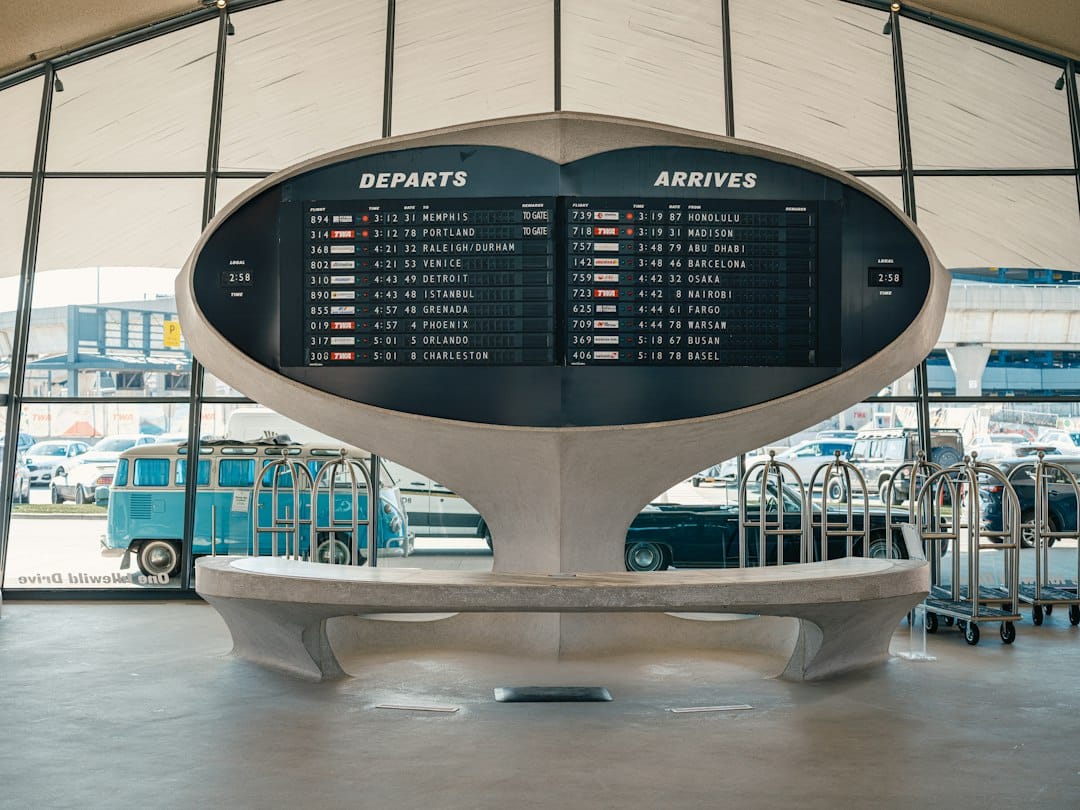
Picture the scene. The departures board glows amber above you, the queue at the bag-drop counter coils back on itself twice, and the clock on your phone reads fifty-one minutes to departure. You shuffle forward. Somewhere behind the counter, an agent glances at a screen and then at the line, and you can feel the quiet arithmetic happening. Fifty minutes. Forty-eight. The queue moves one family at a time. This is the moment when an abstract number printed in an airline's terms and conditions suddenly becomes the most important fact in your life.
That number, for a huge share of domestic flights, is 45 minutes. It is not a suggestion about when to arrive or a polite nudge from the airport. It is a hard line, the point at which check-in closes and bags stop being accepted for your flight. Miss it by a minute and you may find yourself rebooked, charged, or simply turned away while your plane boards a few hundred metres down the concourse.
For anyone living a location-independent life, where flights are less a holiday ritual and more a regular part of the working month, understanding this rule properly changes how you move through airports. It turns departure day from a low hum of anxiety into something closer to choreography. Here is what the rule really means, why it exists, how it shifts depending on where and how you fly, and how to build a travel day around it with calm to spare.
What the 45-Minute Rule Actually Means
At its simplest, the 45-minute rule is a check-in cutoff. Many airlines require that, for domestic flights, you are fully checked in and any hold luggage has been tagged and accepted no later than 45 minutes before the scheduled departure time. Departure time here means the moment the aircraft is due to push back from the gate, not the moment it lifts off the runway, and not the boarding time printed on your pass. That distinction matters more than most people realise, because the boarding time is usually already half an hour or so ahead of departure, which means the 45-minute cutoff lands surprisingly close to when the gate starts calling passengers forward.
It helps to think of departure day as a series of doors closing one after another. First, the check-in and bag-drop door shuts at roughly 45 minutes. Then boarding opens, often somewhere between 30 and 40 minutes before departure depending on the aircraft and airline. Finally, the gate itself closes, commonly around 15 minutes before pushback, after which even a passenger with a valid boarding pass standing at the desk may not be allowed on. Each door is independent. Getting through the first one in time does not guarantee you will reach the last, especially if a long security line sits between them.
The rule is often confused with general advice about when to arrive at the airport, the familiar two hours for domestic and three for international. Those figures are recommendations designed to absorb queues, security and the walk to your gate. The 45-minute rule is different in kind: it is the deadline, the point past which the airline is no longer obliged to process you. Recommendations give you comfort. Cutoffs give you consequences.
Why Airlines Draw the Line Where They Do
Stand near a large window overlooking the apron and you can watch the reason unfold. Baggage carts snake out from the terminal in little trains, each one loaded according to flight and destination, and the bags you handed over at the counter have a long journey through conveyor belts, screening machines and sorting halls before they reach the hold. That journey takes time, and every bag must be screened and matched to a passenger who is actually on board. A cutoff around 45 minutes gives the ground crew a fixed moment to stop accepting new luggage and finish loading without delaying pushback.
There is paperwork behind the scenes too. Airlines need to finalise the passenger list, calculate weight and balance for the aircraft, and in many cases share passenger information with authorities before departure. Late additions ripple through all of those processes. When a passenger checks in at the last moment, someone has to update the manifest, recalculate figures and possibly reshuffle seats. The cutoff exists so that this work can be completed calmly rather than in a scramble that pushes the whole flight off schedule.
And then there is punctuality itself. A short-haul aircraft might fly four or five sectors in a single day, and a ten-minute delay on the first flight can compound into an hour by evening. From the airline's perspective, a firm cutoff protects every passenger on every later flight that aircraft will operate. Seen that way, the agent who politely closes the counter at 44 minutes is not being unkind. They are protecting the schedule that you, on another day, will be grateful for.
Enjoying this? Get more like it.
Weekly picks for remote workers and digital nomads — tools, destinations, and honest takes, straight to your inbox.
Subscribe free →How the Rule Shifts With Bags, Borders and Airports
How the Rule Shifts With Bags, Borders and Airports
Which deadline you are working to depends on borders and bags.
Illustrative figures — composed for shape, not sourced
The 45-minute figure is a common baseline, not a universal law. The first thing that changes it is luggage. If you travel carry-on only and check in online, many airlines let you skip the counter entirely, and the deadline that matters most becomes the gate closure rather than bag drop. Some carriers set a shorter check-in cutoff for passengers without hold bags, sometimes as little as half an hour on domestic routes. The moment you add a checked suitcase, though, you are bound to the bag-drop deadline, and that is usually where the 45-minute line sits.
Borders change things more dramatically. International flights involve document checks, passport verification and often advance passenger information requirements, so cutoffs for these flights are typically 60 minutes and can stretch longer on long-haul routes or at airports with extra security screening. A traveller who has internalised the domestic 45-minute rhythm can be caught out by an international flight that closed check-in a full quarter-hour earlier. If you hop between countries regularly, it is worth treating every international departure as though its deadline is earlier than you expect until the booking confirmation tells you otherwise.
Airports themselves add their own texture. Some vast hubs have terminals so sprawling that a train ride separates security from your gate, and certain airlines set longer cutoffs at their busiest airports to account for the distances involved. Smaller regional airports can feel almost leisurely by comparison, but their counters may be staffed only for set windows around each departure, which means closures are enforced precisely. The only reliable answer for any given flight is the one printed by the airline that operates it, found in your booking confirmation or on the carrier's check-in information page.
Building Your Buffer Backwards From Departure
Building Your Buffer Backwards From Departure
Plan the day in reverse from departure, then add a cushion on top.
Illustrative figures — composed for shape, not sourced
The most useful way to work with the 45-minute rule is to plan your day in reverse. Start with the departure time and walk the clock backwards. Gate closes around 15 minutes before. Check-in and bag drop close at 45. Now ask yourself honestly how long the queue at bag drop might be at that hour, how long security tends to take at that airport, and how far the gate might be from the checkpoint. Add those together and you have the latest moment you can realistically walk through the terminal doors. Then add a cushion on top, because traffic, a late taxi or a lift that refuses to arrive at your apartment building are all part of the texture of travel.
Online check-in is your quiet ally here. Completing it the evening before, the moment the window opens, means the only thing standing between you and the 45-minute line is the bag-drop queue rather than a full check-in transaction. Saving the boarding pass to your phone, and keeping a screenshot in case the airline's app struggles on airport Wi-Fi, removes one more point of friction. Many seasoned travellers also weigh their bag at home so there is no last-minute repacking on the terminal floor, a small ritual that can save precious minutes when the clock is running down. There are more small efficiencies like these in our guide to the best travel hacks to save time and money.
There is also a gentler, more human side to this planning. Arriving with time to spare changes the entire emotional temperature of a travel day. Instead of watching the queue with clenched jaw, you can buy a coffee, refill a water bottle, and wander past the windows where the morning light is catching the tails of parked aircraft. If you are heading off on a long journey, that unhurried start sets the tone for everything after, and it pairs well with the advice in our piece on what not to do before a long-haul flight.
Working the Rule as a Remote Professional
Working the Rule as a Remote Professional
Schedule your work around the bag-drop deadline, not the other way round.
Illustrative figures — composed for shape, not sourced
For location-independent workers, departure day rarely means a day off. There is a client call that could not be moved, a deliverable due before the time zone shifts, a Slack thread that refuses to go quiet. The temptation is to squeeze one more task in at the apartment and leave at the last possible moment. The 45-minute rule is a useful counterweight to that instinct. Treat the bag-drop deadline as an immovable meeting in your calendar, and schedule your work around it rather than the other way round.
In practice, this often means shifting work to the far side of security. Once your bag is dropped and you are airside, the clock loses much of its menace. The only remaining deadline is the gate, and you can work comfortably until boarding is called. A quiet corner near your gate, a lounge with reliable power sockets, or a café with a view of the runway can become a perfectly serviceable office for an hour. If you have lounge access, it is worth knowing what to expect, and our guide to free food in Priority Pass lounges covers what is typically on offer while you wait.
Experienced remote workers also find that the hour before boarding is best reserved for focused, offline-friendly tasks rather than anything that depends on a fragile connection. Airport Wi-Fi can be slow or crowded, and a video call that drops just as the gate agent announces final boarding is nobody's idea of a productive morning. Downloading documents in advance, drafting emails to send later, and keeping your laptop charged before you leave home all let the airside hour work for you instead of against you.
Connections, Layovers and Where the Rule Stops Applying
Once you are inside the system on a connecting itinerary booked as a single ticket, the 45-minute check-in rule largely fades into the background for your onward flight. Your bags are usually checked through to the final destination and you already hold a boarding pass, so the deadline that matters becomes the gate closure of your next flight. This is a separate concept from the minimum connection time, which is the shortest layover an airport and airline consider workable for transferring between flights. People sometimes blur the two together, but they answer different questions: one is about getting into the system, the other about moving through it.
The picture changes completely when you string together separate tickets. If your second flight is booked independently, perhaps with a different airline to save money, you may need to collect your luggage, leave the secure area, and check in again from scratch. In that case, the 45-minute rule, or the longer international cutoff, applies all over again at the connecting airport, and your layover needs to be long enough to absorb landing, disembarking, immigration if relevant, baggage reclaim and a fresh trip through check-in and security. Creative routings such as open jaw flights can be wonderful for budget and flexibility, but they reward travellers who map out each check-in deadline before booking.
Connections, Layovers and Where the Rule Stops Applying
On a single ticket the check-in cutoff fades; on separate tickets it applies all over again.
Illustrative figures — composed for shape, not sourced
It is worth noting, too, that the rule is about the airline's obligations, and airlines do occasionally show flexibility. A staff member might wave through a passenger moments after the cutoff if the flight is delayed or the bag belts are quiet. But that grace is discretionary, never guaranteed, and it tends to vanish on busy mornings. Planning as though the line is absolute keeps the decision in your hands rather than leaving it to the mood of a crowded terminal.
The 45-minute rule looks small on paper, a single line buried in the fine print of a ticket. Yet it shapes the rhythm of every departure: when you leave home, when you stop working, how long you linger over breakfast and how calmly you walk past the queue at bag drop. Once you understand it as the first of several doors closing in sequence, it stops feeling like a threat and starts feeling like a map, a fixed point around which the rest of the day can be arranged.
So the next time you book a flight, look up the cutoff before you look up the seat map. Note whether you will be checking a bag, whether you are crossing a border, and whether your journey involves separate tickets. Then plan backwards, add a cushion, and give yourself the gift of an airport hour spent with a coffee in hand and the runway glittering beyond the glass, rather than one spent watching the minutes slip away in a queue.
FAQ
what time do airlines stop accepting checked bags
For most domestic flights, airlines stop accepting checked bags 45 minutes before the scheduled departure time, when the aircraft is due to push back from the gate. This is the hard cutoff for check-in and bag drop, and missing it by even a minute can result in being rebooked, charged, or turned away.
is the 45 minute rule different for international flights
Yes, international flights typically have longer cutoffs of around 60 minutes or more due to document checks, passport verification, and advance passenger information requirements. Long-haul routes and airports with extra security screening may have even earlier deadlines.
do I need to check in if I only have carry on luggage
If you travel carry-on only and check in online, many airlines let you skip the counter entirely, and your deadline becomes the gate closure rather than bag drop. Some carriers set a shorter check-in cutoff for passengers without checked bags, sometimes as little as 30 minutes on domestic routes.
do I need to check in again for a connecting flight
If your flights are booked as a single ticket, your bags are usually checked through to your final destination and you already have a boarding pass, so you do not need to check in again. However, if your connecting flight is booked on a separate ticket with a different airline, you must collect your luggage and check in from scratch, which means the 45-minute rule applies again at the connecting airport.
Sources
Illustrative, composed for shape rather than sourced: How the Rule Shifts With Bags, Borders and Airports; Working the Rule as a Remote Professional. Updated 3 Nov 2026.